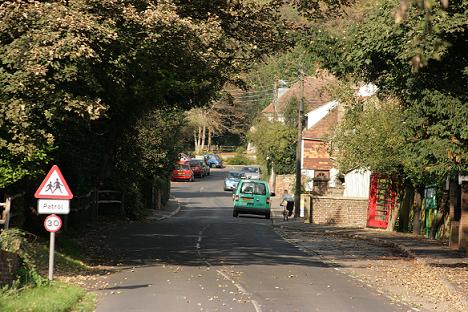
Research and written by George E. Smith
History
There appears to have been a church at
Detling in Saxon times, because one of the first things Lanfranc did when he
was appointed Archbishop of Canterbury after the Norman conquest was to have a
list made of the churches in the diocese noting the dues payable to the
Archbishop at Easter and Detling (DYTLING) appears as one of seventeen churches
subordinate to Maidstone (MAEGDSTANE). These churches paid their dues to the
mother church which in turn paid a larger sum to the Archbishop (1).
The next known mention of Detling
Church is in 12 52 when it is recorded in the Plea Rolls of that year that
luliana, the wife of Ralph de Bubehurst who was charged with complicity in a
murder in Sussex was taken and imprisioned in the Archbishop's prison of Maydenstone
and escaped therefrom to the church of Detlinen - an example of claiming the
right of sanctuary (2).
Detling being a chapelry of
Maidstone followed the fortunes of that parish. Maidstone had been one of the
ancient possessions of the see of Canterbury - a great trial took place at
Penenden Heath when Odo Bishop of Bayeux and half brother of William the
Conqueror wrongfully seized possession of it and appears in Domesday Book under
the title of Lands of the Archbishop.
In 1328 during a brief vacancy in
the see of Canterbury the Prior and Chapter- of Christ Church
Canterbury Ithe cathedral authority), sequestrators of the see, appointed a
Commissioner to carry out a visitation of the parishes in the see. The rector
of Maidstone at that time was the notorious pluralist Cardinal Anibald di
Ceccano, Archbishop of Naples who was of course not resident, the cure being
performed by parochial chaplains. The Commissioner found the vestments and
service books to be neglected and defective, the chancel and nave roof in bad
condition and the sacrarium dirty and ill kept. The rector chaplains and
parishioners were admonished and required to make good the defects under
penalty. There was however no report of moral turpitude among the villagers as
there was in many of the parishes (3).
Archbishop William de Courtney
with the authority of a papal bull and the licence of Richard II created a
college of secular priests in Maidstone in 1396 and assigned to it the rectory
of Maidstone and the chapelries annexed to it, though he retained the right of
patronage. Cranmer transferred these rights to Henry VIII as part of a large
exchange transaction. The spiritual care of Detling was thus in the hands of
the college throughout the fifteenth century and remained so until the college
with all similar ecclesiastical foundations were suppressed at the Reformation.
In 1547 all the college assets were surrendered to the Crown and four years
later Edward V I granted the manor and the rectorial tithes of Maidstone to Sir
Thomas Wyatt of Allington Castle. He however led a rising against Queen Mary
when she married Philip of Spain and was executed as a traitor in 15 53 and his
estates forfeited to the Crown which
again let them out. The barn,
tithes and glebe of the parish of Detling was valued at £7.6.8 a year and the stipend paid to the
curate by the lessee was £2.13.4.
In 1564 Queen Elizabeth 1 granted the
reversion of the rectory to the Archbishop, since when it has remained part of
the possessions of the see of Canterbury (4).
In 1573 Archbishop Parker appointed a
commissioner to visit and report upon the parishes in the diocese (Detling was
exempt from the jurisdiction of the Archdeacon (5) and reported "that the
chauncell is not sufficiently repayred in the defalte of my Lord of Canterbury's
Grace, that there Vicar is not resident upon his cure: Item they have had no
sermons this twelvemonth". The Vicar was also Vicar of Bearsted (BARSTEDE)
and when he officiated at Detling, Bearsted had to make do with a reader, but
they got no sermons either (6).
It will be seen that the curate of
Detling has become Vicar in that report. No record has been discovered to
explain the change of title, but it appears to have come into use under
Archbishop Parker, because it is recorded that Dr John Burcharde was appointed
to the living in 1571 "on the death of the last Vicar" (7). The title has been in use ever
since and although no apportionment of the Vicarial tithes has been traced, the
Rev J Cave Brown believed them to have been farmed out and only a small part of
their value paid to the vicar (8).
After the Restoration Archbishop
)uxon augmented the vicar's stipend in obedience to Charles II's direction to
review the emoluments of poor parishes. He made the stipend f 10 a year, and
Archbishop Tenison left a legacy of £200 further to augment it in 1715 (9)
Detling
appears to have retained a Royalist vicar throughout the Civil war and
interregnum, for William Sutton appointed by Archbishop Laud in 1639 was not succeeded until 1662.
He records baptisms as having being
solemnised on Church Festivals despite the prevailing official sentiment
against such a proceeding (10).
The Building
The church consists of a nave and chancel of equal width and height
(although the chancel roof is slightly higher and of a different pitch from
that of the nave), and a north aisle and chapel. There is also a west tower
with a shingle spire typical of the county.
There is no trace of any Saxon work and the original
of the present building appears to have been a simple nave and chancel of early
Norman construction. The chapel (now occupied by the organ), north aisle, porch
and tower were all later additions. The only work of the original Norman church
now remaining is the south wall, flint and rubble with tufa quoins. A close
scrutiny of the wall reveals the jamb of one of the old windows in the nave.
The present windows were inserted subsequently.
No records of mediaeval. building work have been discovered, and dating
relies on the style. The two arches to the north aisle are Early English
and were presumably inserted on the first
extension of the church by the addition of a narrow lean-to aisle which is
shown in a sketch of the church dated 1809 and which was enlarged to its present size in 1887 to commemorate Queen Victoria's
jubilee.
The arch between the chancel and
the organ chapel appears to be 14th century and led to a small chapel or
chantry built for the private use of the then Lord of the Manor, one of the Sir
William de Detling line. There was an altar in the chapel and a niche still
survives in the south wall which was either a piscina or a credence. Once upon
a time the spear and armour of a Sir William appear to have been displayed in
the chapel, but they have long since disappeared. The sum of one shilling a
year used to be paid by the parish to the owners of the manor for the use of
this chapel, but this acknowledgement has now either been waived or commuted.
The solid and well proportioned
West "rower of flint and rubble outside and hewn chalk inside is
Perpendicular, probably dating to the late 14th century. It has shallow
diagonal buttresses and a graceful cusped threelight window. Until last
century its upper storey was built of weather boarding with a dwarfed capping
spire of shingle. The present upper storey was built in 1861 by the generosity of a Mr William
Peale of Loose. There were formerly four bells but three had become cracked or
broken and were sold in 1861 to help with the cost of repewing the church. One of the poppyhead ends
from the original pews is in Maidstone Museum.
The chancel was "restored" and its
present roof installed in 1878 by the Ecclesiastical Commissioners as owners of the great tithes.
The Windows
The east window of the chancel is
early Perpendicular and the window in the tower of a similar period or perhaps
a little earlier, say late fourteenth century. The windows in the south wall
are much later than the wall itself and the remaining windows are modern. All
the glass is modern, mostly being donated as memorials and made by Heaton
Butler and Bayne.
The south window is a memorial
window to Canon Horsley. The window depicts "The Sower" who is said
to have the face of Canon Horsley. His daughter Mildred is also commemorated in
this window. She was knocked down and killed by an Air Force lorry in The Street
at Detling while delivering milk with her yoke and pails, the regular milkman
having gone to the war. The east window in the organ chapel is a copy of the
east window at Headcorn.
The window in the north aisle is
a memorial to the seven parishioners who died in the 1914-18 War and the twenty seven who
served in it. One of the victims was Mary Perpetua Mildred Horsley who was
killed in Detling while engaged in war work as a milkmaid. The centre light of
the window shows St Martin, our patron saint, as a Roman soldier with a
pastoral staff indicating his later life as a missionary bishop in France. He
died in 401 A.D. at Tours. The other lights give respectively St Perpetua
an early Christian Martyr at Carthage in 203, and St Mildred, a Kentish
Princess who founded and ruled the Abbey of Minster in Thanet and died in 690. The face is that of Miss Horsley
whose Christian names were those of the two saints depicted.
Fittings & Furniture
The Font, a massive twelve-sided basin lined with lead, is so plain as to be
undatable but its size and simplicity argue considerable age. Pevsner suggests
perhaps thirteenth century (11). The columnar support is modern but is
believed to be a copy of the earlier support.
The Pulpit, is a good modern imitation of the perpendicular style and was purchased
from All Saints Maidstone where it had stood from 1846 until it was replaced by the
present stone pulpit.
Communion Plate
The church plate comprises:
1) a silver chalice patten and flagon with London
hallmarks of 1713 bearing the arms of Thomas Bliss
who was a native of Maidstone and at times its Mayor and Member of Parliament.
In 1714 he became the lessee of the tithes
of Maidstone and its chapelries of Detling and Loose but appears to have no direct
connection with the village (12). A modern cross has
been placed on the domed crown of the flagon with a hallmark of 1888.
2) An almsdish of silver London halimarked 1840 presented by the Rev
Richard Cobb, its Vicar at that time. These are naturally not in every day use
and they are not kept in the church.o:p>
The Monuments
There are the usual wall tablets
to past notables of the parish, but the only monument of artistic merit is that
to Mary Foot who died in 1778. This is to be found on the south wall of the
chancel and consists of a shallow altar tomb of black marble surmounted by a
projecting canopy of stone in the form of a triple ogee gable.
Pevsner (11) describes it as "a delightful piece of Strawberry Hill
confectionery exquisitely carved but utterly unarchaeological".
There are traces of former brasses on one or two
flagstones but all brass has vanished and they are very worn.
On the north face of the pillar by
the font has been inserted the upper part of a tomb slab with the excellently
preserved figure of a tonsured priest which was found face downwards in the
wall of the narrow north aisle when it was enlarged in 1887. This pillar also bears a niche
which may be where the font was originally sited.
Above the font is displayed an
enlargement of the seal of the Corporation of Dover which seal was made in 1304 and shows the charity of St Martin
our patron saint who shared his military cloak with a beggar
There is also an interesting grave
slab inside the chancel rails which reads.
''Here lieth ELIZABETH GODFREIA the wife of
Thomas Godfreye, a /urat of Lydd which departed this life the VII of September
Anno Domini 1589”
The Churchyard
The most notable feature of the churchyard is the
massive yew tree beside the path from the porch to the gate with its imposing
trunk. At one time its branches overhung the roadway but by the generosity of
Mr ) S Rugg and his brother-in-law Mr William Peale of Loose the roadway was
diverted and its original site thrown into the churchyard. Detling church owes
a great deal to the generosity of the Rugg family and Mr Peale.
Unfortunately time has not dealt gently with the inscriptions on the
tombstones. The oldest which it is still possible to read are seventeenth
century, one beside the church path and one below the east window. Several well
carved eighteenth century stones may also be found.
The Rev Canon J W Horsley
From 1911 to 1921, Detling had a
very remarkable man as Vicar. This was Canon I W Horsley who devoted his life
to the well-being of his disadvantaged fellows. His first curacy was at
Shoreditch in East London where he was also Chaplain to Clerkenwell Gaol. He
made many suggestions for prison reform and the rehabilitation of criminals
which were in advance of his time, but which have since been adopted. He came
to believe that the welfare of children was the foundation of a sound community
and when Clerkenwell Gaol was closed became Clerical Secretary of the Waifs and
Strays Society, known today as The Children's Society. Subsequently he held
livings in other poor parts of London and whereever he went became active in
local politics in the interests of the under priviliged. He had the large crypt
of one of his churches cleared and turned into a children's playground, and was
Mayor of Southwark in 1910. His health deteriorated and he 'retired' to the
vicarage at Detling in 1911, but remained very active in good
works. He stood for membership of the County Council as a Labour candidate in
1912, but was defeated. He did serve, however, on the Parish Council. While he was
at Detling the village children had the run of the Vicarage garden as a
playground. He was a keen alpinist and naturalist and took annual parties to
Switzerland until just before his death in 1921 , a few months after his
retirement from the vicarage.
Notes- - _.
|
i I I
|
Archaeoligica Cantiana Vol 45 (1933) p.60
|
171
|
Detling in Days Gone By p 44
|
|
121
|
Detling in Days Gone By
|
181
|
Ibid p.20
|
|
|
bv LCave-Brown (1880)
|
191
|
Hasted Vol IV
|
|
i3i
|
Arch Cant Vol 33
(1918) p.88
|
(10)
|
Detling in Days Gone By pp 47-8
|
|
i<li
|
The Histon and Survey of Kent by
|
(11)
|
The Buildings of England, North East
|
|
|
Edward Hasted Vol IV (1798)
|
|
and East Kent by john Newman. Penguin
|
|
ISI
|
Ibid
|
|
Books (1969)
|
|
Ibl
|
Arch Cant Vol 29 (1911) pp 270-305
|
1121
|
Arch Cant. Vol 26 (1904) pp 224-5
|
The preparation of these notes has been greatly helped by a small publication, Detling
in Days Gone By (1880) by a former
Vicar, Rev I Cave-Brown. This booklet has been reprinted by Detling Parish
Council and copies may be purchased from the parish Clerk.